Beyond Awareness: Understanding Autism Awareness, Acceptance, and Appreciation
– By Prabhleen Singh
April is widely recognized around the world as a time to bring attention to autism. For many years, this period was known primarily as Autism Awareness Month, encouraging people to learn more about autism and the experiences of autistic individuals and their families.
Over time, the conversation has grown. Today, many people also speak about Autism Acceptance and Autism Appreciation, recognizing that awareness alone is only one part of building a more inclusive and supportive society.
Each of these perspectives offers something meaningful. Together, they create a more complete understanding of autism and how to better support autistic individuals.
The Role of Awareness
Awareness is often the first step toward understanding. It focuses on helping people learn what autism is, how it may affect communication, behaviour, and sensory experiences, and why early support and inclusive environments matter.
For many families, awareness has played an important role in helping communities recognize autism and encouraging conversations that once felt difficult or misunderstood. Increased awareness has also helped improve access to resources, education, and services.
However, awareness alone does not always lead to meaningful inclusion. Simply knowing about autism is different from truly understanding and respecting autistic individuals as valued members of the community.
Moving Toward Acceptance
This is where the idea of Autism Acceptance has become increasingly important.
Acceptance encourages society to move beyond simply recognizing autism and instead focus on creating environments where autistic individuals feel respected, supported, and included. It acknowledges that autism is a natural part of human diversity and that people should not have to change who they are to belong.
Acceptance can take many forms. It may mean adjusting environments to reduce sensory overload, offering flexible communication styles, or recognizing that different ways of thinking and interacting are valid.
Many of these shifts in language and perspective have been shaped by autistic self-advocates who have shared their lived experiences and helped guide the conversation.
At its core, acceptance asks communities to shift from expecting autistic individuals to fit into existing systems to creating systems that welcome different needs and perspectives.
Celebrating Through Appreciation
More recently, many advocates have also begun using the term Autism Appreciation.
Appreciation goes one step further by recognizing the strengths, talents, and contributions of autistic individuals. Rather than focusing only on challenges, it highlights creativity, problem-solving, unique perspectives, and the many ways autistic people enrich the world around them.
For some individuals, appreciation also means celebrating autistic identity and embracing neurodiversity as an important part of the human experience.
This perspective encourages people to see autism not only through a lens of support needs but also through a lens of value and respect.
How These Perspectives Work Together
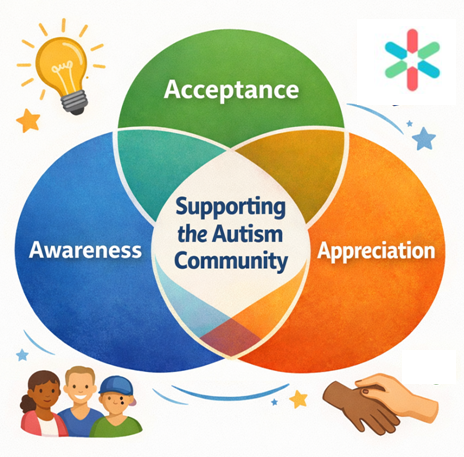
While awareness, acceptance, and appreciation are sometimes discussed separately, they are often most powerful when they work together.
- Awareness helps people learn and understand.
- Acceptance helps communities create inclusive environments.
- Appreciation encourages society to recognize strengths and celebrate contributions.
On their own, each perspective has value. Together, they create a more complete and meaningful approach. Awareness can open the door to understanding, acceptance helps ensure individuals feel respected and included, and appreciation encourages people to recognize the strengths and contributions within the autism community.
When combined, these perspectives help move beyond simply recognizing autism toward building communities where autistic individuals feel supported, valued, and genuinely included.
Recognizing Autism Month Today
Today, many organizations and advocates choose to recognize April in ways that reflect all three perspectives. Some continue to emphasize awareness and education, while others focus more strongly on acceptance and appreciation.
There is space for all of these approaches.
What matters most is that the conversation continues to grow in ways that support autistic individuals and their families. By learning, listening, and building more inclusive environments, we can move toward a future where understanding and respect are central to how we recognize autism.
April can be a time not only to learn about autism but also to recognize and celebrate the diversity, strengths, and experiences that autistic individuals bring to the world.