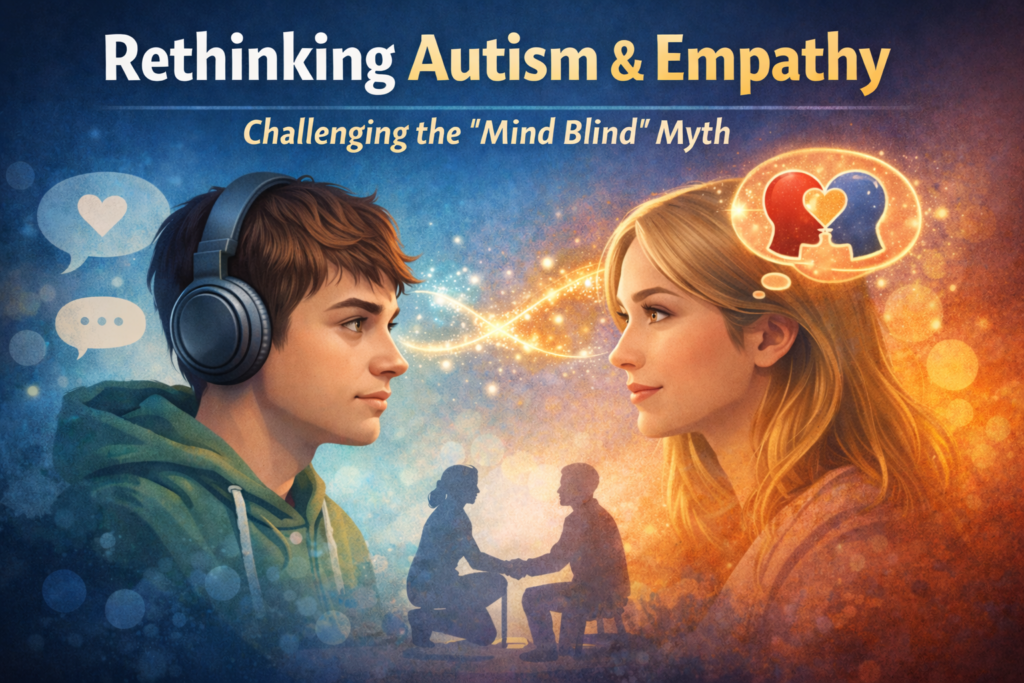
Rethinking an Old Autism Myth: Why Autistic People Are Not “Mind Blind”
For many years, a common belief about autism has been that autistic people are “mind blind.” This phrase suggests that autistic individuals cannot understand what others are thinking or feeling. The idea became widely known in psychology and often led to the assumption that autistic people lack empathy.
However, new analysis and discussion from researchers are challenging this long-standing belief. Many experts now argue that the concept of “mind blindness” oversimplifies autism and does not accurately reflect how autistic people understand others. In reality, autistic individuals may simply experience and express social understanding in different ways.
You can read the original discussion from researchers at Durham University here.
Where the Idea Came From
The concept of “mind blindness” comes from research on something called theory of mind – the ability to recognize that other people have their own thoughts, feelings, beliefs, and intentions. This skill helps us understand and predict how others might behave in different situations.
In the 1980s and 1990s, some psychologists suggested that autistic people have difficulty with theory of mind. From this, the idea developed that autistic individuals might struggle to understand the mental states of others.
Over time, this theory became one of the most influential explanations for autism in psychology. It appeared in academic papers, textbooks, and media discussions, often shaping how autism was explained to the public.
But as research has continued, scientists have begun to question whether this explanation tells the whole story.
What New Research Suggests
Recent analysis of autism research shows that the evidence behind the “mind blindness” idea is more complicated than once believed.
Many early studies relied on narrow laboratory tests designed to measure whether someone could predict what another person believes in a specific scenario. While these tests were useful for research, they may not accurately reflect how people understand others in real-world situations.
In everyday life, social understanding is far more complex. Studies have shown that autistic individuals can often recognize emotions, understand other people’s perspectives, and respond with empathy – especially when communication happens in familiar or meaningful contexts.
The results across studies are also highly varied. Some autistic participants perform well on traditional theory-of-mind tests, while others find them challenging. This variation suggests that autism cannot be explained by a single deficit in understanding other minds.
A Different Perspective: Communication Differences
Many researchers now believe that social differences in autism may be better explained by differences in communication styles and perspectives, rather than a lack of empathy.
Autistic individuals may interpret social cues differently or rely on different information when understanding emotions. For example, they might focus more on patterns, details, or logic rather than subtle facial expressions or tone of voice.
These differences can sometimes make communication between autistic and non-autistic people more challenging. However, it does not mean that autistic individuals are unable to understand or care about others.
Some experts describe this as a two-way communication gap, sometimes referred to as the “double empathy problem.” In this view, both autistic and non-autistic people may find it difficult to fully understand each other’s perspectives.
Why This Shift Matters
Moving away from the “mind blindness” stereotype is important for several reasons.
First, it challenges the harmful misconception that autistic people lack empathy. Many autistic individuals describe having deep emotional awareness and compassion for others.
Second, it helps reduce stigma. When autism is framed mainly in terms of deficits, it can create misunderstandings about autistic people’s abilities and experiences.
Finally, a more balanced understanding encourages better support strategies. Instead of trying to “fix” autistic social behavior, researchers and educators can focus on improving communication and understanding between different ways of thinking.
A More Inclusive Understanding of Autism
As research continues, the conversation around autism is evolving. Increasingly, scientists and advocates emphasize the idea of neurodiversity – the understanding that human brains work in many different ways.
Autistic people may perceive and interpret the world differently, but that does not mean they lack empathy or awareness of others.
Instead of viewing autism through the lens of “mind blindness,” many researchers now believe it is more accurate to recognize the rich diversity of human thinking – and the importance of learning how different minds can better understand each other.