Chris Abildgaard, Ed.D., NCSP, LPC, NCC
The Social Learning Center | University of Hartford
What I have noticed through my years as a consultant and mental health clinician is that parents and educators are often given long lists of strategies for supporting autistic and other neurodivergent individuals. I am, in fact, guilty of such practices. What I have come to understand is that the more useful question, however, is not “Which intervention is best?” but “What is getting in the way of access, participation, communication, regulation, or belonging for this person in this moment?” This access-oriented question is consistent with neurodiversity-affirming frameworks that emphasize autonomy, belonging, quality of life, and support that reduces barriers rather than normalizes autistic people (Lerner et al., 2023; Zaks, 2025). Neuro-affirming support begins by recognizing that behavior is information and communication that we often misread. A student who leaves a noisy classroom, a child who refuses an unexpected transition, or a young adult who stops responding during a difficult conversation may be communicating overload, uncertainty, fatigue, fear, or a need for greater processing time. We have research that links sensory reactivity, intolerance of uncertainty, anxiety, and communication barriers with autistic people’s participation across settings (MacLennan et al., 2021; Stromberg et al., 2021). Effective intervention therefore starts with curiosity about what an individual needs to feel and be successful, rather than simply seeking compliance.
This perspective is consistent with current practices centered on helping autistic and neurodiverse people be seen, heard, understood, valued, and appreciated for who they are (Autism Today Foundation, n.d.). It also aligns with a central theme in my work with caregivers and professionals: trust grows when communication is clear, respectful, culturally responsive, collaborative, and predictable. In caregiver-professional relationships, active listening, validation, transparent updates, and adapting communication to individual needs are practical tools for reducing uncertainty and strengthening partnership. Those same principles can guide direct support for neurodiverse learners. Below are some helpful examples of ways to shift from simply managing behavior toward providing greater access to experiences and agency.
Intervention 1: Start With Regulation and Experiencing Safety
Learning is difficult when a person is using most of their available energy to manage sensory input, uncertainty, social demands, or emotional distress (MacLennan et al., 2021; Stromberg et al., 2022). Before adding prompts, rewards, consequences, or more verbal instruction, adults should ask themselves whether the environment itself is creating a barrier. Practical regulation supports can include access to a quieter location, reduced visual clutter, headphones or ear protection when appropriate, movement opportunities, flexible seating, predictable breaks, and permission to use self-regulatory behaviors that are safe. For some individuals, the most effective intervention is not teaching them to tolerate an overwhelming environment; it is adapting the environment enough that participation becomes possible.
Parents can use the same principle at home by identifying patterns around difficult routines. Instead of viewing a recurring struggle as defiance, track what happens before, during, and after the situation. Is the demand occurring after a long school day? Is hunger, fatigue, noise, a change in plans, or an unclear expectation contributing? Educators can conduct a similar “access check” before interpreting behavior. Emerging literature on autistic burnout reinforces the importance of recognizing prolonged stress, exhaustion, and reduced functional capacity rather than simply escalating expectations when participation declines (Raymaker et al., 2020).
Intervention 2: Make the Invisible Visible
Many daily expectations depend on information that adults assume is obvious: how long an activity will last, what “clean up” means, when help is available, what happens after an assignment is finished, or how much work is enough. These hidden demands are especially stressful for neurodivergent learners because executive functioning affects initiation, planning, organization, working memory, self-monitoring, flexible problem solving, and the ability to use what one knows at the right moment. In related work on executive functioning, we know that these difficulties can affect how children learn new information, apply previously learned skills, solve everyday problems, and move through home routines successfully (Abildgaard et al., 2020). Neurodivergent learners may therefore benefit when hidden information is made concrete and visible. Visual schedules, written checklists, first-then formats, models of finished work, timers, calendars, and step-by-step task maps can reduce cognitive load by making expectations, sequence, and completion criteria more explicit (Abildgaard et al., 2020; CAST, 2024).
The goal is not to make life rigid or create individuals who expect the world to just change for them. The goal is to make expectations understandable. A useful strategy is “preview, prepare, and update.” Preview what is likely to happen, prepare the individual for the parts that may be difficult, and update them promptly when plans change. When a change is unavoidable, adults can name what is staying the same as well as what is changing. For example: “The assembly is moved to the gym. Lunch is still at 12:10, you will still sit with your class, and we can look at the gym before the assembly starts.” Predictability becomes relational when another person reliably helps make the environment understandable.
Intervention 3: Reduce Language Load and Increase Processing Time
When stress rises, receptive and expressive language can become less efficient. Adults often respond by talking more, repeating themselves, or asking multiple questions. That can unintentionally increase demand. A more effective approach is to use concise language, pause, and provide a visual or written option. One direction at a time is often more accessible than a string of instructions. Questions can be converted into choices when appropriate: “Do you want to start with the first problem together or read the directions first?”
Caregivers and educators should also distinguish between delayed responding and not understanding. Waiting several seconds after a question, allowing typing or pointing instead of speech, and accepting “I need more time” as meaningful communication can improve participation. Communication support is not limited to people who use augmentative and alternative communication. All learners benefit when adults offer more than one way to receive information and more than one way to respond.
Intervention 4: Build Choice into Demands
Choice is one of the simplest ways to increase agency without removing important expectations. The adult can preserve the goal while offering flexibility in how, where, when, or with whom the task is completed. A student might choose to demonstrate learning through a short written response, recorded explanation, visual product, or structured conference. At home, a child may choose whether to shower before or after a preferred activity, which of two foods to pack, or which step of a routine to complete first.
This approach is compatible with Universal Design for Learning (UDL), which emphasizes multiple means of engagement, representation, and action or expression (CAST, 2024). Research on UDL-based interventions suggests that flexible access and scaffolding can support academic, social, and behavioral participation for learners with disabilities (AlRawi & AlKahtani, 2022).Choice should be authentic rather than cosmetic: both options must be acceptable to the adult, and the individual should be able to communicate when neither option is workable.
Intervention 5: Teach Skills in Natural Contexts
Some skills are best learned in the routines where they will be used. Parent-mediated naturalistic developmental behavioral interventions provide one example of this principle, particularly for young autistic children. Recent systematic reviews indicate that coaching parents to embed responsive, developmentally informed strategies into everyday interactions can improve targeted developmental skills and parent implementation (Song et al., 2025; Wang et al., 2024). The larger lesson extends beyond any one intervention model: support is more likely to generalize when it is practiced during real play, meals, homework, community activities, transitions, and conversations.
Naturalistic teaching should remain responsive to the person rather than turning every interaction into therapy. Follow interests, notice communication attempts, create opportunities for shared attention without demanding eye contact, and reinforce meaningful self-advocacy. A special interest can become a bridge to literacy, social connection, career exploration, or emotional regulation. The aim is not to make a neurodivergent person appear less neurodivergent; it is to expand access, communication, competence, and autonomy (Lerner et al., 2023; Zaks, 2025).
Intervention 6: Co-Regulate Before Expecting Self-Regulation
Self-regulation develops within relationships and supportive environments (Rosanbalm & Murray, 2018). When a learner is overwhelmed, the adult’s tone, pace, facial expression, and proximity can either reduce or intensify the situation. Co-regulation may mean lowering one’s voice, reducing words, creating physical space, acknowledging the difficulty, and helping the person identify a next manageable step. Statements such as “I can see this is a lot right now” or “We can figure out the next step together” communicate support without requiring the individual to explain everything while dysregulated.
After the situation has passed, adults can collaboratively review what helped and what should change next time. This is also the time for repair. If an adult misunderstood, pushed too hard, or communicated poorly, a direct apology can strengthen rather than weaken authority. Trust is built through repeated experiences in which the neurodivergent person learns that adults will listen, clarify, prepare, support regulation, and repair ruptures.
Intervention 7: Coordinate Home and School Without Blaming Either
Parents and educators often see different versions of the same individual. A student may hold themselves together at school and unravel at home or may function well at home but struggle with the sensory, executive-function, and social demands of school. These differences should generate questions, not accusations. Regular, concise check-ins can identify patterns in sleep, transitions, workload, peer stress, medication changes when relevant to the family, sensory demands, and successful supports, which is consistent with school-based inclusion work that emphasizes contextually responsive support across environments (Tsou et al., 2024).
Communication should be strengths-based and actionable. Instead of sending home only a report that a student “had a bad day,” describe the context, what the student communicated, what adults tried, and what appeared to help. Caregivers should likewise be invited to share strategies that work outside school. My caregiver-focused work emphasizes that empathy, clear language, validation, cultural and linguistic responsiveness, transparent updates, and shared decision-making are foundational to effective partnership. These are not “soft skills”; they are intervention infrastructure that helps create the conditions for access, agency, and belonging (Lerner et al., 2023; Zaks, 2025).
A Simple Framework: Connect, Clarify, Prepare, Co-Regulate, Repair
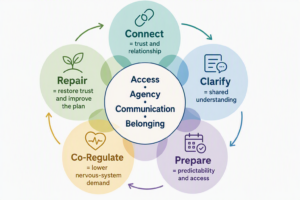
Parents and educators do not need to memorize dozens of disconnected techniques. A practical sequence is to ask five questions. Connect: Have I established enough trust to influence this situation? Clarify: Does the person understand what is happening and what is expected? Prepare: Have I provided sufficient predictability, visual information, practice, or transition support? Co-Regulate: Am I helping lower the demand on the nervous system rather than adding to it? Repair: If the interaction did not go well, have we revisited it in a way that restores trust and improves the plan?
The visual below is meant to be read as a set of connected supports, not as a step-by-step formula, consistent with Universal Design for Learning’s emphasis on flexible pathways for access, engagement, expression, and learner agency (CAST, 2024). In real situations, these practices often blend. When adults build connections, it becomes easier to clarify what is expected. When expectations are clear, preparation is more effective. When a person feels prepared, stress is more likely to decrease. Co-regulation helps keep support available during hard moments because self-regulation develops through predictable, responsive, and supportive caregiving relationships and environments (Rosanbalm & Murray, 2018). Repair helps rebuild trust afterward. Used together, these practices help create more accessible, responsive conditions for agency, communication, and belonging.
Figure. These practices are shown as overlapping because they often support one another in real life. Together, they help adults create more accessible, responsive conditions for agency, communication, and belonging. (Abildgaard, 2026)
Conclusion
The strongest interventions are not necessarily the most complicated. Parents and educators can make a meaningful impact on a person’s life by reducing unnecessary barriers, increasing predictability, supporting communication, embedding authentic choice, teaching skills in natural contexts, co-regulating during stress, and coordinating across settings. These practices work best when the neurodivergent individual is included as an active partner in determining what helps, consistent with neurodiversity-affirming intervention frameworks that prioritize autonomy, quality of life, access, and belonging (Lerner et al., 2023; Zaks, 2025). Intervention should not be measured by the extinction of a target behavior. We should ask ourselves whether the person has greater access, agency, understanding, connection, and belonging. When those outcomes become the target, support becomes less about making a person fit the environment and more about building environments and relationships in which that person can participate authentically.
References
Abildgaard, C., Theriault, J., Murphy, N., & Scully, L. (2020). Executive functioning: Four areas to address at home. Autism Parenting Magazine, 104, 12–17. https://www.autismparentingmagazine.com/issue-104-transition-strategies-for-kids-with-autism/
AlRawi, J. M., & AlKahtani, M. A. (2022). Universal design for learning for educating students with intellectual disabilities: A systematic review. International Journal of Developmental Disabilities, 68(6), 800–808. https://doi.org/10.1080/20473869.2021.1900505
Lerner, M. D., Gurba, A. N., & Gassner, D. L. (2023). A framework for neurodiversity-affirming interventions for autistic individuals. Journal of Consulting and Clinical Psychology, 91(9), 503–504. https://doi.org/10.1037/ccp0000839
MacLennan, K., Rossow, T., & Tavassoli, T. (2021). The relationship between sensory reactivity, intolerance of uncertainty and anxiety subtypes in preschool-age autistic children. Autism, 25(8), 2305–2316. https://doi.org/10.1177/13623613211016110
Autism Today Foundation. (n.d.). Mission. https://www.autismtoday.com/about-autism-today-foundation/mission/
CAST. (2024). Universal Design for Learning Guidelines version 3.0. https://udlguidelines.cast.org/
Rosanbalm, K. D., & Murray, D. W. (2018). Co-regulation from birth through young adulthood: A practice brief (OPRE Brief #2017-80). Office of Planning, Research and Evaluation, Administration for Children and Families, U.S. Department of Health and Human Services. https://acf.gov/opre/report/co-regulation-birth-through-young-adulthood-practice-brief
Song, Y., Kong, X., Fu, W., & Song, F. (2025). Parent-mediated interventions based on the NDBI for children with ASD: A systematic review of randomized controlled trials. Journal of Autism and Developmental Disorders. Advance online publication. https://pubmed.ncbi.nlm.nih.gov/40120018/
Stromberg, M., Liman, L., Bang, P., & Igelström, K. (2022). Experiences of sensory overload and communication barriers by autistic adults in health care settings. Autism in Adulthood, 4(1), 66–75. https://doi.org/10.1089/aut.2020.0074
Zaks, Z. (2025). Moving to a neurodiversity-affirming paradigm in the support system: Autistic professionals as paradigm change. Neurodiversity, 3, 1–13. https://doi.org/10.1177/27546330241294138
Tsou, Y.-T., Kovács, L. V., & Louloumari, A. (2024). School-based interventions for increasing autistic pupils’ social inclusion in mainstream schools: A systematic review. Review Journal of Autism and Developmental Disorders. https://doi.org/10.1007/s40489-024-00429-2
Wang, X., et al. (2024). Comparison of the efficacy of parent-mediated NDBIs on developmental skills in children with ASD and fidelity in parents: A systematic review and network meta-analysis. BMC Pediatrics, 24. https://doi.org/10.1186/s12887-024-04752-9
Raymaker, D. M., Teo, A. R., Steckler, N. A., Lentz, B., Scharer, M., Santos, A. D., Kapp, S. K., Hunter, M., Joyce, A., & Nicolaidis, C. (2020). “Having all of your internal resources exhausted beyond measure and being left with no clean-up crew”: Defining autistic burnout. Autism in Adulthood, 2(2), 132–143. https://doi.org/10.1089/aut.2019.0079
About the Author
Dr. Chris Abildgaard, NCSP, LPC, NCC, holds a Doctor of Education from Loyola University Chicago with a concentration in School Psychology. He is a nationally recognized speaker and clinician whose work focuses on autism, neurodiversity, executive functioning, mental health, and school psychology.
He is the Owner and Director of the Social Learning Center in Cheshire, Connecticut, and is a Clinical Assistant Professor in the Psychology & School Psychology Department at the University of Hartford. His professional work emphasizes practical, strengths-based, neurodiversity-affirming supports across home, school, clinical, and postsecondary settings.